
Inside the Brown County Most Wanted Program
Brown County does not publish a named most wanted roster. What it offers is a tipline plus a county warrant report, and the two serve different purposes. The Brown County Sheriff's Tipline collects information about suspected criminal activity from anyone willing to share it. It lists no people. It cannot check a warrant for you, and it is not a warrant lookup of any kind. The county's real warrant records live on the Outstanding Warrants page, which links a warrant report and repeats one rule twice. Every warrant must be confirmed with the issuing agency. Nobody should confront, approach, or try to apprehend another person. Note: Brown County runs no reward program, no named most wanted roster, and no warrant roundup.
Brown County Warrant Tip Form Questions
The Brown County tipline form is short and can be filed anonymously. Reading the fields first makes a report easier to submit and easier for an investigator to use.
| Your name, phone, and email | Optional. Leaving them blank keeps the tip anonymous. |
|---|---|
| How you want to be contacted | Required choice: no contact, email, evening phone, or daytime phone |
| What is your tip | Required. The page asks for city, date and time, address, and specifics |
| Email copy | Optional checkbox for a copy of your own message |
| Bot check | Required before the form will submit |
The official Brown County Sheriff's Tipline page carries the form and the safety banner above it.
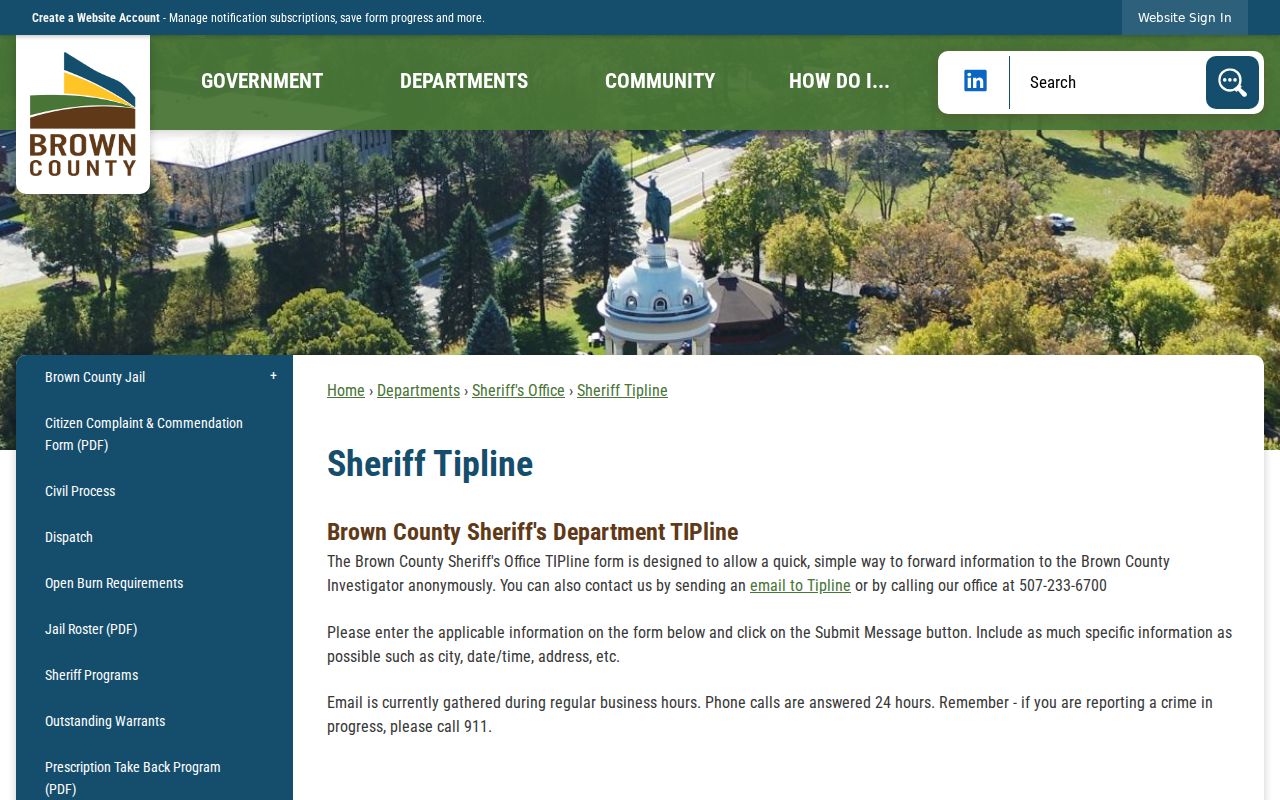
No field on that form asks for a warrant number. That alone tells you a tip and a warrant check are two different errands, and confusing them wastes time on both ends. Timing rules matter too. The tip line phone is answered around the clock, while email is handled during regular business hours. A crime in progress belongs on 911, never in a web form. Brown County also gives you a contact preference field. Fill that one with care, because it decides whether an investigator can reach you at all. Pick the option you will actually answer.
How Brown County Most Wanted Lists Work
A most wanted list and an active warrant list are not the same document. A most wanted list is a curated subset: an agency picks a handful of cases for publicity, usually because it wants help locating someone. An active warrant list is the fuller working list that court and sheriff systems maintain, and it shifts constantly as warrants are served, recalled, or cleared. Brown County publishes the second kind. Its county warrant report covers criminal matters venued in Brown County District Court and is updated nightly. The county warns the report can differ from court records and from the Sheriff's warrant system, so treat it as a lead rather than a verdict. Note: neither a curated list nor a full warrant list replaces a call to the issuing agency.
Brown County Warrant List Removal Notice
Brown County's warrant list comes with a caveat. The official link leads to a one-page Sheriff's Office notice. That notice says the related jail roster was pulled because of ongoing scam activity. The warrant landing page still posts its phone numbers, along with its confirmation warning. An older search-indexed copy of the same report showed the field pattern: a warrant number, an issue date, a comments field, a name, and a date of birth. Treat no cached copy as current. If the report will not load, pick up the phone instead. A call to the office answers what a stale file cannot. That step works whether the list returns or stays down.
Sending a Most Wanted Tip Safely
The tipline exists so a person who knows something can pass it along without stepping into the middle of a case. Brown County states the rule plainly on its warrant page. Do not approach or try to hold anyone. Let the sheriff handle that.
Three Rules:
Call 911 for a crime in progress or immediate danger.
Use the tip form for information about past or suspected activity, not for an emergency.
Never confront, follow, or detain a person yourself.
The tip line is not a warrant confirmation channel. Brown County's court and sheriff answer that question. The intake form does not.
What a Useful Brown County Tip Contains
A tip an investigator can act on shares a few features. It says what was seen, when, and where. It separates what you observed from what you heard secondhand, and it leaves conclusions about guilt out of it.
- The city or township and the street or address involved
- The date and the time you saw or learned of the activity
- What you actually observed, described plainly
- Whether you want to be contacted, and how
One caution applies here too. A tip is not a report to a court, and filing one does not make investigative data public. Brown County can protect active investigation records and unserved warrant index data under Minnesota data practices law.
How Most Wanted Differs From an Active Warrant
Most wanted and active warrant get used as if they meant the same thing. They describe different things, kept by different offices, with different limits.
| What It Is | Who Keeps It | What It Tells You |
|---|---|---|
| Most wanted list | An agency, for publicity | That the agency wants help locating someone |
| Active warrant list | Court and sheriff systems | That a warrant may still be enforceable |
| Court case record | Brown County District Court | The charge, the events, and the current status |
Only the issuing court or the sheriff's office can confirm which category a Brown County case falls into. A name missing from a list does not prove that no warrant exists.
Brown County Warrants and the Response Unit
Not every warrant gets served by one patrol deputy. In Brown County, high-risk search and arrest warrants can go to the Emergency Response Unit, a combined team that draws personnel from Brown, Redwood, Renville, and Lyon counties. The Sheriff Programs page describes that unit. It also covers routine patrol work. Brown County spreads across 16 townships and about 1,060 roadways, and the sheriff serves as the police contact for Comfrey and Hanska plus the unincorporated parts of the county. That is a wide beat. What you will not find there is a list of names. The page explains how the office handles its warrant work, not who is wanted.
When You Believe You Are Listed
Seeing your own name on a public page is jarring. The first instinct is usually the wrong one. Do not phone the tip line about yourself. Do not approach an officer on the street to sort out a Brown County warrant. Call the court that holds the case, and speak with an attorney who practices in Minnesota.
If a warrant may be active in your name: call Brown County District Court Court Administration at 507-441-7020 and the Sheriff's Office at 507-233-6700, using numbers you looked up yourself. Ask about the case, the bond, and a voluntary appearance.
Keep a paper trail as you go. Write down the case number, who you spoke with at the Brown County court, and what they told you to do next. Then follow through before the next court date passes.
Scam Calls About Brown County Warrants
Scammers work the warrant angle hard. Brown County's roster-removal notice flags scam activity, and the Minnesota Judicial Branch has posted its own warning about jury and warrant impersonation scams. The script rarely changes. A caller poses as an officer or a court employee and demands money to stop an arrest. Real courts do not work that way. They never settle a warrant over the phone with a gift card, cryptocurrency, or a wire transfer. If someone pressures you for same-day payment, hang up, look up the courthouse or Sheriff's Office number yourself, and call it. Then report the caller to the agency he claimed to represent.